El Diablo: significado de la carta del tarot
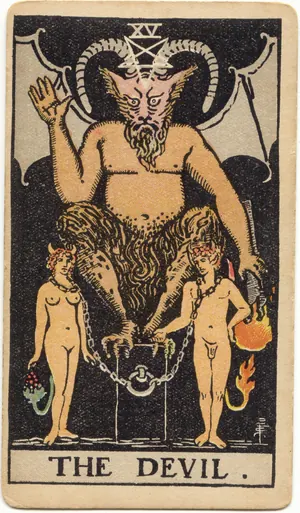
El Diablo es el arcano mayor número XV (15) del tarot. Según A. E. Waite (1910), en posición normal significa: estrago, violencia, vehemencia, esfuerzos extraordinarios, fuerza, fatalidad, aquello que está predestinado, pero que no es malo por esa razón. Invertida: fatalidad maligna, debilidad, mezquindad, ceguera.
Contenido con fines culturales y de entretenimiento.
Descripción de la imagen según Waite
El diseño es un acomodo, término medio o armonía entre varios motivos mencionados en la primera parte. El Macho Cabrío Cornudo de Mendes, con alas como las de un murciélago, está de pie sobre un altar. En la boca del estómago está el signo de Mercurio. La mano derecha está alzada y extendida, y es lo inverso de aquella bendición que da el Hierofante en la quinta carta. En la mano izquierda hay una gran antorcha encendida, invertida hacia la tierra. En la frente hay un pentagrama invertido. Delante del altar hay una argolla, de la que parten dos cadenas hasta los cuellos de dos figuras, masculina y femenina. Estas son análogas a las de la quinta carta, como si fueran Adán y Eva después de la Caída. Aquí está la cadena y la fatalidad de la vida material.
Las figuras tienen cola, para significar la naturaleza animal, pero hay inteligencia humana en los rostros, y aquel que está exaltado por encima de ellas no ha de ser su amo para siempre. Aun ahora, él es también un siervo, sostenido por el mal que hay en él y ciego a la libertad del servicio. Con más de su habitual burla hacia las artes que aparentaba respetar e interpretar como maestro en ellas, Eliphas Lévi afirma que la figura bafomética es la ciencia oculta y la magia. Otro comentarista dice que en el mundo Divino significa la predestinación, pero no hay en ese mundo correspondencia con las cosas que abajo son propias de la bestia. Lo que sí significa es el Morador del Umbral fuera del Jardín Místico, cuando son expulsados de él quienes han comido el fruto prohibido.
Texto original (inglés)
The design is an accommodation, mean or harmony, between several motives mentioned in the first part. The Horned Goat of Mendes, with wings like those of a bat, is standing on an altar. At the pit of the stomach there is the sign of Mercury. The right hand is upraised and extended, being the reverse of that benediction which is given by the Hierophant in the fifth card. In the left hand there is a great flaming torch, inverted towards the earth. A reversed pentagram is on the forehead. There is a ring in front of the altar, from which two chains are carried to the necks of two figures, male and female. These are analogous with those of the fifth card, as if Adam and Eve after the Fall. Hereof is the chain and fatality of the material life.
The figures are tailed, to signify the animal nature, but there is human intelligence in the faces, and he who is exalted above them is not to be their master for ever. Even now, he is also a bondsman, sustained by the evil that is in him and blind to the liberty of service. With more than his usual derision for the arts which he pretended to respect and interpret as a master therein, Eliphas Lévi affirms that the Baphometic figure is occult science and magic. Another commentator says that in the Divine world it signifies predestination, but there is no correspondence in that world with the things which below are of the brute. What it does signify is the Dweller on the Threshold without the Mystical Garden when those are driven forth therefrom who have eaten the forbidden fruit.
Descripción según Mathers: «El Diablo»
Un demonio cornudo y alado con garras de águila (de pie sobre un altar al que están atados dos diablos más pequeños mediante un collar y una cuerda). En la mano izquierda lleva un cetro rematado en llama. Es la imagen del Destino o la Fatalidad, buena o mala.
Texto original (inglés)
A horned and winged demon with eagle's claws (standing on an altar to which two smaller devils are bound by a collar and cord). In his left hand he bears a flame-headed sceptre. He is the image of Fate or Fatality, good or evil.
Significado adivinatorio
Waite (1910)
Estrago, violencia, vehemencia, esfuerzos extraordinarios, fuerza, fatalidad; aquello que está predestinado, pero que no es malo por esa razón.
Texto original (inglés)
Ravage, violence, vehemence, extraordinary efforts, force, fatality; that which is predestined but is not for this reason evil.
Mathers (1888)
Fatalidad para bien
Texto original (inglés)
Fatality for Good
El Diablo invertida
Waite: Fatalidad maligna, debilidad, mezquindad, ceguera.
Mathers: Fatalidad para mal
Preguntas frecuentes sobre esta carta
Correspondencias
Astrología relacionada
Combinaciones con otras cartas
Cartas relacionadas
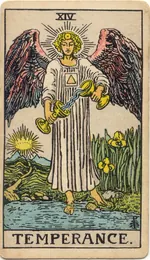 La Templanza
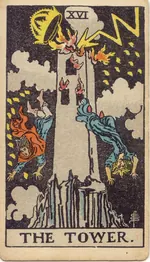 La Torre
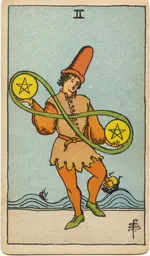 Dos de Oros
 Tres de Oros
 Cuatro de Oros
Más relaciones
Edición: Sophia · Última actualización: