El Carro: significado de la carta del tarot
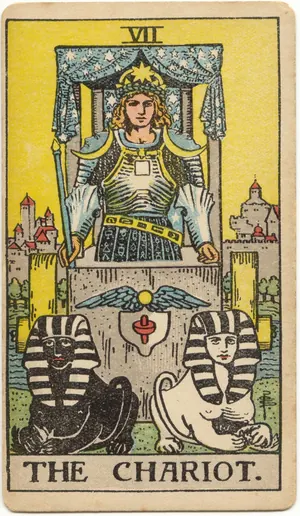
El Carro es el arcano mayor número VII (7) del tarot. Según A. E. Waite (1910), en posición normal significa: socorro, providencia, guerra, triunfo, presunción, venganza, perturbación. Invertida: motín, riña, disputa, litigio, derrota.
Contenido con fines culturales y de entretenimiento.
Descripción de la imagen según Waite
Una figura erguida y principesca que porta una espada desenvainada y que corresponde, en líneas generales, a la descripción tradicional que he dado en la primera parte. Se supone que sobre los hombros del héroe victorioso están el Urim y el Tumim. Ha llevado cautiva la cautividad; es la conquista en todos los planos: en la mente, en la ciencia, en el progreso, en ciertas pruebas de iniciación. Así ha respondido a la Esfinge, y por esta razón he aceptado la variante de Eliphas Lévi: dos esfinges tiran así de su carro. Es, ante todo, el triunfo en la mente.
Por esta razón debe entenderse (a) que la pregunta de la esfinge concierne a un Misterio de la Naturaleza y no del mundo de la Gracia, al cual el auriga no podría ofrecer ninguna respuesta; (b) que los planos de su conquista son manifiestos o externos, y no están dentro de sí mismo; (c) que la liberación que efectúa puede dejarlo a él mismo en la servidumbre del entendimiento lógico; (d) que las pruebas de iniciación por las que ha pasado triunfalmente han de entenderse física o racionalmente, y (e) que si llegara a las columnas de aquel Templo entre las cuales está sentada la Sacerdotisa, no podría abrir el rollo llamado Tora, ni podría responder si ella lo interrogara. No es la realeza hereditaria ni es el sacerdocio.
Texto original (inglés)
An erect and princely figure carrying a drawn sword and corresponding, broadly speaking, to the traditional description which I have given in the first part. On the shoulders of the victorious hero are supposed to be the Urim and Thummim. He has led captivity captive; he is conquest on all planes—in the mind, in science, in progress, in certain trials of initiation. He has thus replied to the Sphinx, and it is on this account that I have accepted the variation of Eliphas Lévi; two sphinxes thus draw his chariot. He is above all things triumph in the mind.
It is to be understood for this reason (a) that the question of the sphinx is concerned with a Mystery of Nature and not of the world of Grace, to which the charioteer could offer no answer; (b) that the planes of his conquest are manifest or external and not within himself; (c) that the liberation which he effects may leave himself in the bondage of the logical understanding; (d) that the tests of initiation through which he has passed in triumph are to be understood physically or rationally and (e) that if he came to the pillars of that Temple between which the High Priestess is seated, he could not open the scroll called Tora, nor if she questioned him could he answer. He is not hereditary royalty and he is not priesthood.
Descripción según Mathers: «El Carro»
Es un símbolo de lo más complejo e importante, que ha sido restaurado por Eliphas Levi. Representa a un Conquistador coronado y portando un cetro, montado en un carro cúbico rematado por cuatro columnas y un dosel, y tirado por dos caballos, uno de los cuales mira al frente mientras el otro vuelve la cabeza hacia él. (En la figura completa de una sola cabeza se muestran dos ruedas.) Representa el Triunfo y la Victoria de la Justicia y el Juicio.
Texto original (inglés)
This is a most complicated and important symbol, which has been restored by Eliphas Levi. It represents a Conqueror crowned and bearing a sceptre, riding in a cubical chariot, surmounted by four columns and a canopy, and drawn by two horses, one of which looks straight forward, while the other turns his head towards him. (Two wheels are shown in the complete single-headed figure.) It represents Triumph, and Victory of Justice and Judgment.
Significado adivinatorio
Waite (1910)
Socorro, providencia; también guerra, triunfo, presunción, venganza, perturbación.
Texto original (inglés)
Succor, providence; also war, triumph, presumption, vengeance, trouble.
Mathers (1888)
Triunfo, Victoria, Superación de obstáculos
Texto original (inglés)
Triumph, Victory, Overcoming obstacles
El Carro invertida
Waite: Motín, riña, disputa, litigio, derrota.
Mathers: Derrocado, Vencido por los obstáculos en el último momento
Preguntas frecuentes sobre esta carta
Correspondencias
Astrología relacionada
Combinaciones con otras cartas
Cartas relacionadas
 Los Enamorados
 La Fuerza
 Siete de Bastos
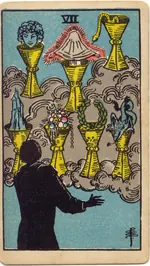 Siete de Copas
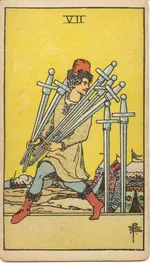 Siete de Espadas
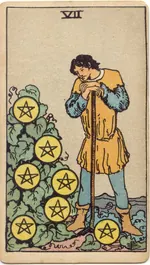 Siete de Oros
Más relaciones
Edición: Sophia · Última actualización: